Europe on the way to technological sovereignty? The EU’s Tech Sovereignty Package
According to the European Commission, the European Union depends on non-EU countries for more than 80% of its key digital products, services and infrastructure. In times of geopolitical tension in both the West and the East, this dependence is becoming a risk for security and the economy. With the European Technological Sovereignty Package put forward on 3 June 2026, the European Commission has launched its most ambitious effort to date to strengthen technological sovereignty in the EU. The proposals have the potential to provide a boost to digital products and services “made in Europe”.
The overall aim of the package is to strengthen the EU’s technological independence in key sectors, ranging from semiconductors to cloud and AI infrastructure and open source. The energy supplies needed to achieve this are also taken into account. The EU defines technological sovereignty as the ability to make critical value chains resilient, competitive and free from external dependencies.
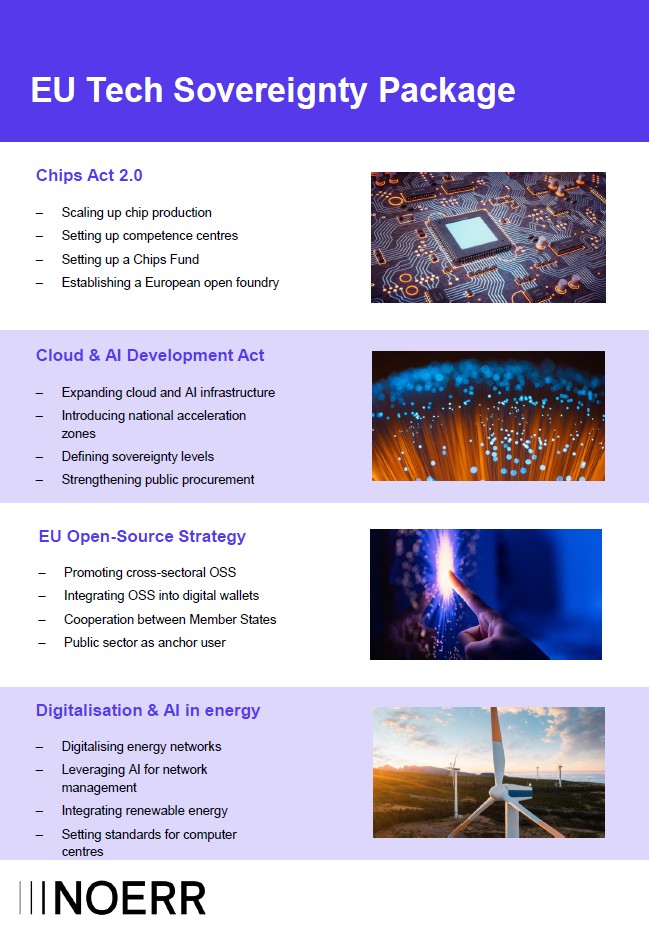
The Tech Sovereignty Package consists of four interlinked initiatives:
- the Chips Act 2.0;
- the Cloud and AI Development Act (CADA);
- the EU Open Source Strategy;
- the Strategic Roadmap on digitalisation and AI in the energy sector.
The Chips Act 2.0 and the CADA are to become binding EU law through regulations. The Open Source Strategy and the Roadmap on digitalisation and AI in the energy sector set out political guidelines and are policy centred. This means that they will primarily have an indirect impact through procurement and funding mechanisms.
Chips Act 2.0
The Chips Act 2.0 builds on the existing Chips Act, which established an EU-wide legal framework in 2023 to strengthen the European semiconductor ecosystem. The Chips Act 2.0 significantly expands that framework for the European semiconductor industry and gives it a stronger industrial policy focus.
Key components include an updated “Chips for Europe Initiative 2.0”, which focuses on establishing semiconductor centres of excellence and a “Chips Fund” for start-ups, scale-ups and SMEs. To this end, alongside traditional funding, new instruments such as joint technology projects (“grand challenges”) and exchange formats between manufacturers and customers (“demand forum” and “demand accelerators”) are to be used to pool and stimulate demand. These initiatives are complemented by new instruments for monitoring supply chains and crisis response, such as the Commission’s right to request information and its power to designate priority contracts. Finally, the proposal envisages a project to establish a European open foundry for state-of-the-art chips, including AI chips and 3D packaging.
Cloud and AI Development Act (CADA)
The Cloud and AI Development Act (CADA) complements the Data Act and aims to systematically expand European cloud and AI capabilities and to strengthen technological sovereignty in the field of infrastructure.
While the Data Act, which came into force in September 2025, established EU-wide rules specifically for switching between cloud providers, the CADA goes further. Apart from supporting switching between providers, it now specifically promotes sovereign cloud and AI services to reduce the EU’s dependencies.
To achieve this objective, the draft CADA relies on three main instruments:
- First, Member States are to designate at least one “data centre acceleration zone” within their territory, where accelerated approval procedures and a single point of contact for operators will make it easier to expand data centre capacities.
- Second, the CADA provides for an EU-wide sovereignty framework with four “Union assurance levels” for cloud services, which (especially at the higher levels) are linked to examination procedures and independent audits. In this way, the EU is integrating its cloud sovereignty framework from the Commission’s Cloud III DPS call for tenders into the draft regulation. Sovereignty criteria are thus being codified across the EU. Verifiable criteria for comparing supposedly sovereign cloud offerings will be of great importance going forward for the cloud market, and above all for European providers, who have long been competing with solutions from non-EU providers advertised as sovereign.
- Third, public procurement is to act as a steering mechanism: public bodies in Member States and the EU itself will have to carry out a risk assessment before entering into contracts for cloud services. In critical areas relating to the maintenance of public order, public entities may only award contracts to providers with defined assurance levels.
EU Open Source Strategy
The EU’s Open Source Strategy aims to promote the development and use of open-source solutions across the board, strengthening European customers’ ability to exercise control. The EU is focusing on use of open-source solutions throughout the entire lifecycle of digital products, ranging from research and development, scaling, market launch and deployment to long-term maintenance. The strategy should be understood not as a single measure, but as a framework for future projects.
With this in mind, the EU has identified four main areas of action: first, open-source solutions are to be integrated more directly into key European digital initiatives, such as the European digital identity wallet. Second, closer liaison with and among Member States is envisaged, mainly through a Digital Infrastructure Consortium acting as a coordinating body. Third, there are plans to strengthen the public sector as a key user and co-creator of open source, for example through public procurement guidelines and open-source-friendly procurement processes. Fourth, the EU is specifically focusing on promoting open-source solutions in key areas such as cloud computing, AI and cybersecurity.
Strategic Roadmap for digitalisation and AI in the energy sector
The Strategic Roadmap for digitalisation and AI in the energy sector links digital policy and energy policy – two core areas of European regulation in recent years – and now connects these with the goal of technological sovereignty. The roadmap reflects the objectives of the European Green Deal and refers to existing EU legal and policy instruments such as the Energy Efficiency Directive, European Grids Package and REPowerEU strategy.
The roadmap views digitalisation as a key lever for integrating renewable energies and achieving greater energy efficiency. Smart grids, smart meters, data-driven flexibility solutions and AI-based grid control are to be rolled out at a faster pace and contribute to reducing peak loads and managing energy consumption more efficiently.
At the same time, the roadmap focuses on the sustainability of digital infrastructure: for data centres, plans include a European rating system, models for better integration into the energy system (also by using waste heat) and possible minimum energy-efficiency standards.
A leap forward for the European digital economy?
The Tech Sovereignty Package has the potential to trigger a shift in European technology policy. Unlike earlier statutes such as the AI Regulation or the Data Act, the EU is not merely regulating individual technologies or sectors. Instead, it is focusing on the digital value chain, including the energy supplies needed to sustain it. Its main pillars are the Chips Act 2.0 and the Cloud and AI Development Act, both of which are particularly well-placed to strengthen the semiconductor sector and sovereign cloud solutions defined by sovereignty levels. Dependence on non-EU countries, which is perceived as a geopolitical risk, could therefore shift the regulatory approach away from single-market integration towards rules on digital value chains that are more strongly shaped by security and industrial policy.
The draft regulations will first be negotiated by the European Parliament and the Council. Given this, it remains to be seen whether these consultations will lead to changes to the current package and what they will involve. Parallel to this, the Commission is already pushing ahead with implementing its technology policy agenda: a call for tenders for “AI gigafactories” is expected as early as July. You can follow all further developments in our European Data Legislation Tracker.
For companies based in the EU, it is clear from the announcement of the Tech Sovereignty Package that new requirements and expectations will apply on the European market in relation to sovereign products in the future. Public bodies will adapt their IT architecture and procurement practices and favour sovereign solutions – something that providers will have to be ready for. In the B2B sector as well, the standards set by the EU and the support provided can be expected to have an impact and drive demand for European digital products.
Given this, engaging with the initiatives under the Tech Sovereignty Package at an early stage is essential from both a provider’s and a customer’s perspective in order to manage risks and capitalise on emerging market and funding opportunities. European providers have the chance to be first in line when it comes to marketing sovereign solutions and tapping into new markets.
Authors: Thomas Thalhofer, Lennart Laude, Katharina Köhler


Well
informed
Subscribe to our newsletter now to stay up to date on the latest developments.
Subscribe nowInsights