FAQ on temporary work legislation reforms: Part 1 – Maximum assignment length
The reforms to the German Act on Temporary Agency Work now affect actual practice. Whether temporary agency work, work contracts or services contracts, since 1 April 2017 there has been a new framework for use of outside staff. One of the most important changes is a maximum length of time that temporary agency workers can be assigned to a specific user company. Many questions have already arisen in the wake of these changes, while others are only coming to the fore now that they are actually being applied. We can provide you with some preliminary answers:
How long can agency workers be deployed?
As of 1 April 2017, agency workers can no longer be assigned to a user company for an unlimited period. Section 1 subsection 1b sentence 1 of the Act on Temporary Agency Work now sets down a maximum assignment period of 18 months. Once this time limit has expired, an agency worker may no longer be hired out to the same user company. Instead, that worker may only be hired out to the same company again after a three-month period has passed.
The maximum duration of assignments only applies to times as of 1 April 2017. For assignments of outside staff already running before 1 April, periods prior to this do not have to be taken into account when calculating the maximum duration.
How is the statutory maximum duration of assignments calculated?
The maximum duration of assignments depends on the times when the assignments of the specific agency worker take place. This means that the relevant length of the temporary employment starts on the first day of the actual assignment and ends on the last day, regardless of how the temporary worker’s hours are structured within the user company’s business. Hence, the maximum duration of an assignment will not be exceeded simply because a longer assignment was agreed in the temporary staffing agreement.
How exactly the maximum length of 18 months for assignments should be calculated is currently subject to heated debate:
| Calendar-based calculation | Quasi-commercial calculation |
Federal Employment Agency ("mixed calculation") |
|
|
|
No prevailing opinion exists on this point up to now. Anyone wanting to rule out the risk of exceeding the maximum assignment period should take the earliest possible time as a basis.
The agency and user company should also check existing temporary staffing agreements and make sure that future contracts already prevent interpretation problems on this matter by using clear wording.
The maximum assignment period is “employee-related”. What does this mean?
The maximum assignment period is linked to the assignment of a specific individual agency worker. This means that the assignment of this agency worker at one and the same user company has to end no later than when the maximum assignment period expires. A new assignment with this user company is only permissible after a break of at least three months.
Extending the assignment is not possible if the agency worker is to work in the same company but in different positions. Similarly, changing the agency during an ongoing assignment does not have any effect on the maximum duration of an ongoing assignment. Even if the agency changes, the same agency worker may not be deployed at a user company for longer than 18 months.
In contrast, rotation models by the user company continue to be feasible: agencies can supply the user company with a different agency worker at the end of the maximum assignment period without the previous assignment being counted. It is still possible to fill positions at the user company with alternating agency workers on a long-term basis.
Is it possible to deviate from the statutory maximum assignment period of 18 months?
The maximum duration is essentially dependent on any collective bargaining arrangements, meaning that it is possible to deviate from it (either upwards or downwards) by means of an existing or new collective bargaining agreement. The relevant rules in the collective bargaining agreement for the sector where the employee is assigned, i.e. that of the user company, are determinative. The following possibilities to deviate are therefore open to companies that are either bound or not bound by collective wage agreements:
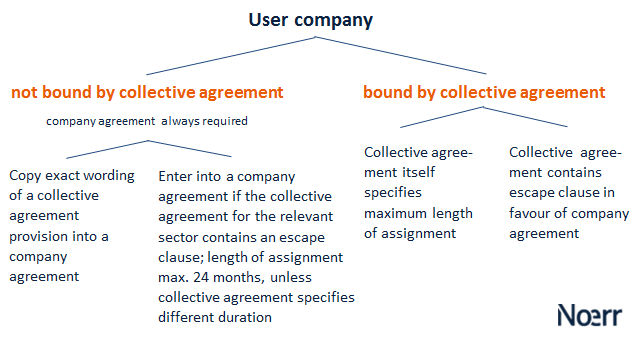
Thus, user companies would be wise to monitor relevant collective bargaining regimes or, where possible, set down special company rules in a company agreement or services agreement.
For their part, agencies should ask about the collective bargaining law in effect at the user company before each assignment in view of the maximum period for assignments and keep themselves informed of any changes.
What are the consequences of not observing the maximum assignment period?
If the maximum assignment period is not observed, there is first of all a risk of the following penalties:
- employment relationship deemed to exist between agency worker and user company
Exception: agency worker submits in good time a written declaration of desire to remain with existing employer; - administrative offence: fines up to €30,000 for both the agency and the user company.
The agency also risks losing its licence for hiring out temporary workers.
Companies should look into what tools can be used to reliably monitor the length of assignments and interruptions for each individual agency worker and implement appropriate measures in order to avoid penalties. We would be happy to help you do this by using our HR Compliance Healthcheck. Should you have any other questions, please contact Lars Kutzer or Daniel Happ.

Well
informed
Subscribe to our newsletter now to stay up to date on the latest developments.
Subscribe nowInsights