Deployment of external personnel: No protection against concealed temporary employment
Whenever the existence of temporary employment requiring a permit has been called into doubt, it has so far been quite common practice for such doubts to be countered by obtaining and keeping an temporary employment permit for all eventualities so that its “curative” effect can be relied upon whenever employee leasing requiring a permit is incorrectly designated as a works contract. At the end of last year, we reported that in a case of concealed temporary employment, the Baden-Württemberg Regional Labour Court (LAG) assumed a fiction of employment with the “lessee” although the “lessor” had a valid temporary employment permit (judgement of 3 December 2014; file No. 4 Sa 41/14; Pseudo-contracts for work: provision of temporary-employment no longer ‘plan B’). The hope at that time that the judgement would be an isolated, not a generalised case has been banished by the grounds of the judgement which have been recently published. The LAG compels IT and compliance officers to act because it calls into question the hedging strategy used to date which, in cases of concealed temporary employment, so far prevented establishment of employment with the alleged “lessee”.
Judgement of the LAG Baden-Württemberg
The plaintiff was assigned to the defendant expressly under a works contract (purposely agreed and described as such) with various third parties, but employed by the defendant on a permanent basis for three years in the same position after a personal interview. He was subject to the defendant’s directions and fully integrated into its working organisation. For the plaintiff, it was not discernible – either from his employment contract or under the alleged leases/work contracts with the third parties – how his legal position was actually to be classified.
The court considered it proven that the defendant and the third parties had deliberately concealed from the plaintiff that he was working under concealed temporary employment and not on the basis of works contracts. It is therefore a breach of good faith if the defendant and third parties later wished to classify the situation as temporary employment and rely on the existence of an temporary employment permit to render it admissible without there having previously been any evident intention in that direction. The actual practice thereby contradicts previous behaviour (venire contra factum proprium) and reliance on the temporary employment permit is not admissible. The LAG thereby created a new access to Sections 9, 10 of the German Act on Temporary Employment (“AÜG”) since, without an temporary employment permit, concluded agreements are invalid and a fiction of employment between the plaintiff and the defendant under Sec. 10 AÜG arises.
Criticism
The judgement clearly states that whoever intends to rely on the possession of an temporary employment permit must make this clear to all parties from the beginning. Specifically, this is to be done in the relevant contract. The grounds of the judgement, however, give the impression that satisfying the court on this point was not really possible: a contract that was excessively specific would have deviated too quickly and too easily from actual practical performance while an excessively vague contract would have rapidly been accused of being intransparent.
The question of how to deal with cases in which the legal nature of the assignment cannot clearly be specified and deviations from the works contract, service contract or employee lease arise as a result of incorrect performance, remains. It is then likely that there was no deliberate attempt to conceal temporary employment at the time of conclusion of the contract, yet how would the court assess the accusation that a concealed employee lease was not prevented, acknowledged or remedied?
It remains to be seen in the case in question how the Federal Employment Court (“BAG”) will decide on the appeal that has been filed (file no. 9 AZR 51/15). The last word on this matter has not yet been spoken as is also shown by a further judgement by the LAG Baden-Württemberg of 18 December 2014 (file no. 3 Sa 33/14) which continues to assume the application of the “reserve parachute solution”. What remains, apart from the legal uncertainty, is a clear call for transparency and clarity in practice both in the case of temporary employment and in other forms of deploying external personnel.
Implications for legal practice
Not only as a reaction to the judgement of the LAG Baden-Württemberg but also in preparation for a planned statutory amendment, it is advisable when engaging external personnel to follow a uniform concept. Cost saving and flexibility are often the motives for concluding works contracts, service contracts or temporary employment, but operational structures must also take account of the inherent special characteristics. Only then will it be possible to minimise the risk of avoidable legal consequences with unintended costs being caused by the deployment of external personnel.
The following three-step approach is particularly suited for that purpose:
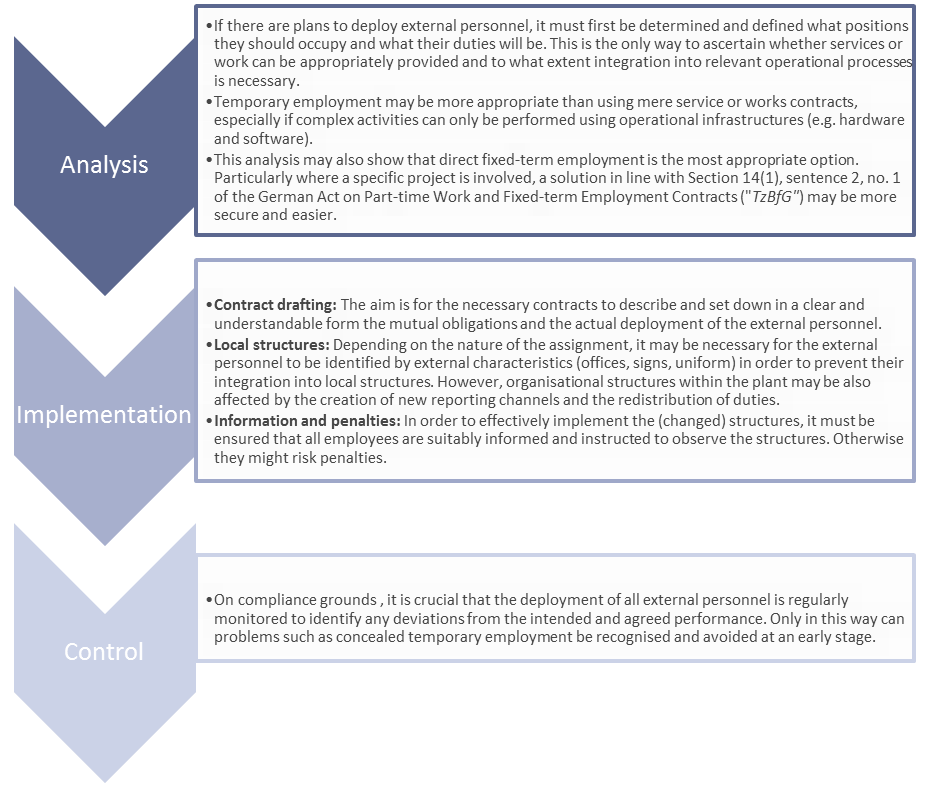
Even if external personnel are already deployed, it is not too late for analysis and controls

Well
informed
Subscribe to our newsletter now to stay up to date on the latest developments.
Subscribe nowInsights