New labelling obligations for commercial guarantees offered by producers and legal guarantee of conformity under the EmpCo Directive – action needed by September 2026
Where traders have not yet aligned their sales practices with the EU’s new labelling obligations, urgent action is required. From 27 September 2026, durability guarantees provided by producers must, subject to certain conditions, be labelled in a harmonised manner throughout the EU, as must information on legal guarantees of conformity. Adjustments will in any event be necessary both in physical retail outlets and in online sales. Where producers voluntarily provide commercial guarantees of durability with certain characteristics, a label must also be affixed to the product itself or placed next to it. Failure to comply with the requirements may give rise not only to claims for injunctive relief and damages, but also to measures by the market surveillance authorities.
I. Legal background
Through Directive (EU) 2024/825 (the “EmpCo Directive”; empowering consumers for the green transition), the European Union aims to enable consumers to make more sustainable purchasing decisions and to combat misleading commercial practices (Recital 1 of Directive (EU) 2024/825). To this end, it has amended both the Unfair Commercial Practices Directive (Directive 2005/29/EC) and the Consumer Rights Directive (Directive 2011/83/EU).
As well as providing protection against misleading marketing practices in the field of sustainable advertising (see our previous article The EmpCo Directive is coming: many green claims face being scrapped in future) (in German only)), a key strand of the reform seeks to make rights under the legal guarantee of conformity and voluntary commercial guarantees offered by producers more transparent. The background to this is the European Commission’s realisation that consumers often do not know about the statutory liability for lack of conformity and frequently confuse voluntary guarantees with rights under legal guarantees of conformity (See recital 26 onwards of Directive (EU) 2024/825). The EmpCo Directive is therefore intended to raise the profile of both regimes, while at the same time creating incentives for more durable products.
Commission Implementing Regulation (EU) 2025/1960 of 25 September 2025 sets out detailed rules on the design and content of labels in different formats. It lays down mandatory rules across the Union for both harmonised notices on rights under the legal guarantee of conformity and harmonised labels for commercial guarantees of durability offered by producers. The new rules will come into force on 27 September 2026 (Article 3 of Commission Implementing Regulation (EU) 2025/1960).
While the Commission Implementing Regulation applies directly, the EmpCo Directive’s requirements primarily amend the German Unfair Competition Act (Gesetz gegen den unlauteren Wettbewerb) and the German Introductory Act to the Civil Code (Einführungsgesetz zum BGB). The duty to provide information on legal guarantees and commercial guarantees now follows directly from Article 246(1) of the Introductory Act.
II. The new labelling obligations
1. Harmonised notice on the legal guarantee of conformity
From the date of application in September, traders selling goods to consumers must provide a harmonised EU notice explaining the legal guarantee rights (See Article 22a of the consolidated Consumer Rights Directive 2011/83/EU). This notice is for information purposes only and does not alter existing consumer rights.
The design of the notice is fully harmonised. In particular, text, elements, colours and a QR code or electronic link to the European Consumer Portal are all prescribed and binding. Traders may not use their own wording or design variations (See the explanatory notes to Annexes I and II to Commission Implementing Regulation (EU) 2025/1960). The information must be displayed prominently both in-store and in online sales. There are no specific rules on exactly how this is to be carried out. The EmpCo Directive gives examples such as a poster in a conspicuous place in a shop (for example on a wall or next to the checkout) or, for online sales, a general reminder on the website (See recital 28 of the EmpCo Directive). In any case, there is no obligation to affix the notice directly to the goods themselves.
In online trade, the notice must also be shown in colour in the format laid down, whereas in offline trade it may be displayed in black and white. In the latter case, the minimum size is A4.
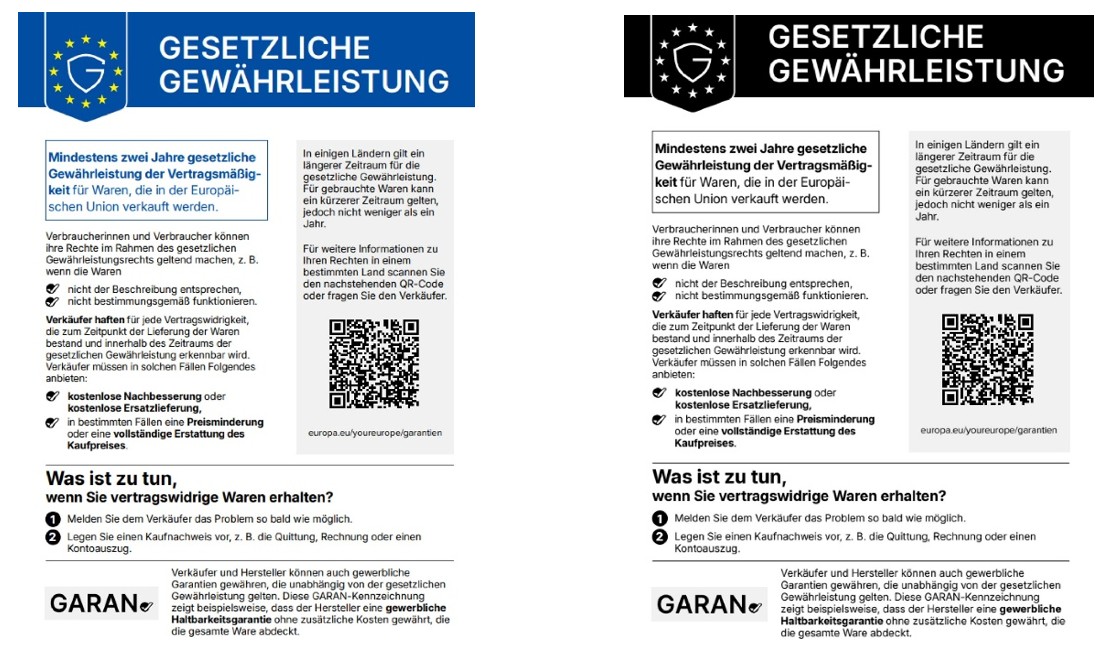
See Annex I to Commission Implementing Regulation (EU) 2025/1960
2. Harmonised labels for producers’ commercial guarantees
In addition, a standardised Europe-wide label for producers’ commercial guarantees of durability is being introduced. However, this label may not be used generally, but only where the producer voluntarily offers the consumer a commercial guarantee of durability at no additional cost, covering the entire good and with a duration of more than two years (Article 5(1)(ea) of the consolidated Consumer Rights Directive 2011/83/EU).
The label is intended to make it immediately clear to consumers that the producer is offering a durability guarantee going beyond the legal guarantee of conformity (Recital 28 of Directive (EU) 2024/825). The design, text and elements of this label are also laid down in EU law and it must be displayed prominently. It may either be affixed directly to the product packaging or displayed in a prominent manner on the shelf where the product is placed; in the case of online sales, the picture should be shown directly next to the product (Recital 28 of Directive (EU) 2024/825).
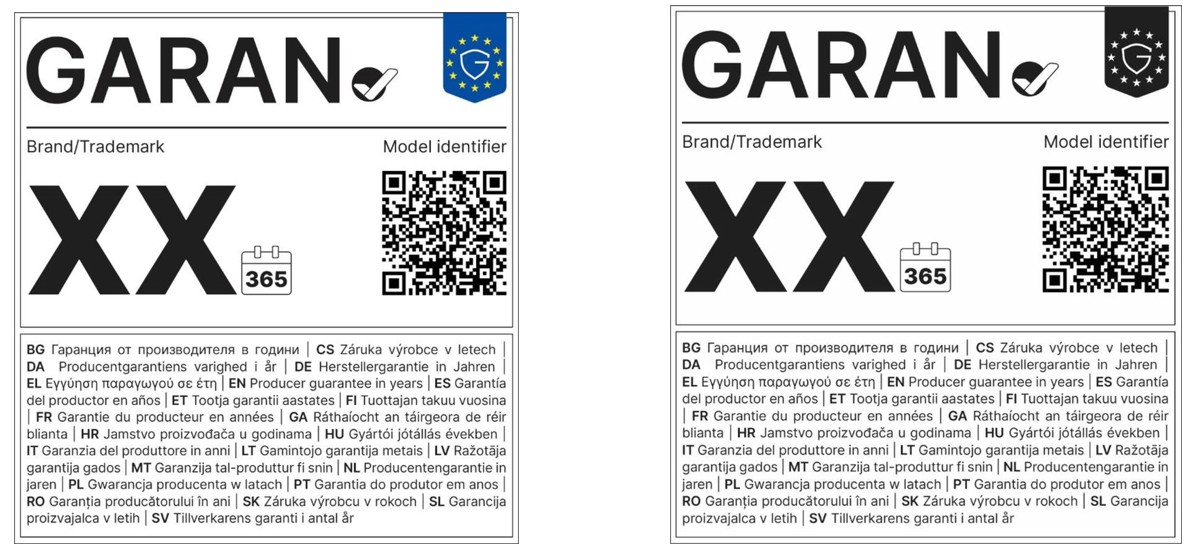
See Annex II to Commission Implementing Regulation (EU) 2025/1960
For contracts entered into via online interfaces, the guarantee label may also be displayed using a nested display, but in that case it must appear in its entirety on the first mouse click, mouse roll-over or tactile screen expansion:

See Annex II to the Commission Implementing Regulation (EU) 2025/1960
3. Scope of application
The information obligations apply in principle to all traders who supply goods to consumers. However, certain goods, such as food or other everyday household items, are excluded (Section 312(2) of the German Civil Code (Bürgerliches Gesetzbuch)). The rules cover both in-store sales and distance selling, in particular online shops. Purely B2B sales, on the other hand, do not fall within their scope of application.
III. Practical implications for traders
The key point in practice is the distinction between the legal guarantee notice and the guarantee label:
- The notice on the legal guarantee is in principle mandatory.
- The guarantee label is to be used only where the producer actually offers a corresponding commercial guarantee.
The new rules entail a considerable need for adjustments in sales and distribution. No transitional arrangements are envisaged for products that have already been manufactured.
The obligation to display the notice on the legal guarantee of conformity applies only to traders that sell the relevant good directly to consumers. In addition, following their assessment of the information provided by the producer, they will in future be required to display or place the harmonised EU guarantee label prominently where that assessment establishes that the producer voluntarily provides, free of charge, a commercial guarantee of durability covering the entire product for a period of more than two years. Producers expecting this to confer a commercial advantage may voluntarily relieve their traders of that task by affixing the label to their product packaging. To assist with implementation, the Commission has published “Practical Guidelines” on its website.
From a legal perspective, it is also important that infringements of these new information requirements may have consequences under unfair competition law. In particular, competitors and qualified consumer organisations may seek injunctions, and consumers may bring claims for damages (Sections 5, 5a and 9 of the German Unfair Competition Act.). In addition, the new labelling obligations are likely to be the subject of increased market surveillance by the authorities in future.
IV. Conclusion
With the EmpCo Directive, the European Union is extending the existing information obligations in consumer sales. For the first time, both the legal guarantee of conformity and voluntary commercial guarantees will be made visible across the Union through standardised labels. Traders should use the remaining period up to 27 September 2026 to align their product labelling, packaging, online shops and internal processes with the new requirements laid down by Union law.

Well
informed
Subscribe to our newsletter now to stay up to date on the latest developments.
Subscribe nowInsights