Germany's Draft Investment Screening Act: What Investors need to know
At a glance
Foreign investors, particularly those from outside the EU and EFTA, will need to take into account stricter review thresholds, an expanded range of sectors subject to screening, and shorter procedural timelines.
Companies should adapt planned transactions to the new requirements at an early stage and closely monitor the further legislative process.
On 22 October 2026, the Federal Ministry for Economic Affairs and Energy (“BMWE”) published the first ministerial draft (Referentenentwurf, the “Draft”) of the long-awaited new Investment Screening Act (Investitionsprüfungsgesetz, “IPG”), supplemented by a draft ministerial ordinance (Investitionsprüfungsverordnung, “IPV”).
The IPG would, for the first time, establish a standalone statutory framework for German investment screening (“FDI screening”) which to date is scattered across different legislative texts (the Foreign Trade and Payments Act (Außenwirtschaftsgesetz, “AWG”) and the Foreign Trade and Payments Ordinance (Außenwirtschaftsverordnung, “AWV”)). The Draft not only consolidates the existing legal framework but provides for targeted changes. Such changes would tighten the existing regime and close remaining loopholes, partly by implementing the revised EU FDI Screening Regulation (Regulation (EU) 2026/1386) applicable as of 17 January 2028 (please find our insights here) and partly reflecting experience gained from precedents.
According to the Draft, “the geopolitical security situation and the risks to national and economic security in Germany have intensified considerably”, not least because “economic means are increasingly being used deliberately to pursue geostrategic objectives”. Hence, the proposed law seeks to enhance the effectiveness of investment screening while at the same time streamlining and accelerating the review process.
Extended scope of investors
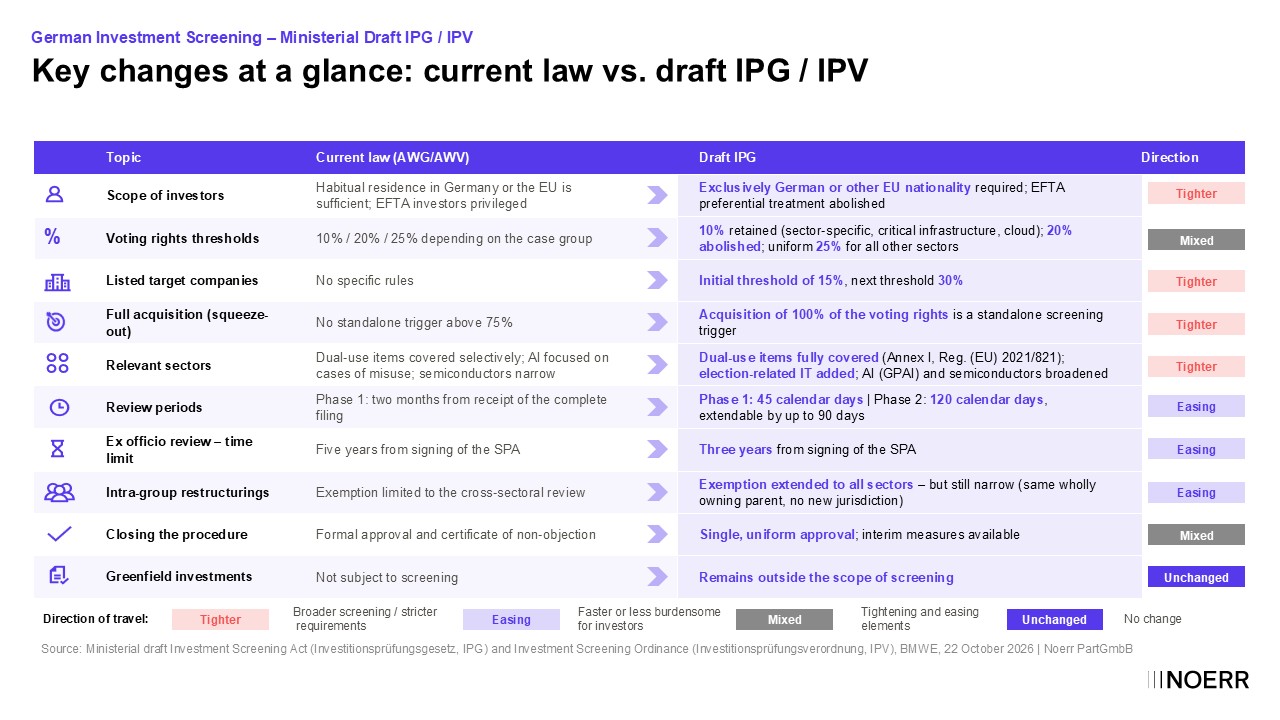
First, the Draft would broaden the personal scope of German FDI screening – to qualify as a domestic or EU investor, habitual residence in Germany or another EU Member State would no longer be sufficient; rather, the investor would additionally have to hold (exclusively) German nationality (or the nationality of another EU Member State). In addition, the preferential treatment currently afforded to investors from EFTA States (Switzerland, Iceland, Liechtenstein and Norway) would be abolished.
Amended voting rights thresholds
Screening would continue to be based on voting right thresholds (as opposed to equity interest):
- While the 10% voting rights threshold would remain in force for defence- and security-related activities (sector-specific review) as well as certain other sectors (e.g., critical infrastructure or cloud computing), the current 20%-threshold would be abolished. A uniform 25% voting rights threshold would apply to all other sectors.
- An acquisition of additional voting rights by an existing investor would continue to trigger a new screening if certain thresholds are exceeded (for sectors with an initial review threshold of 10%, these are 25%, 50%, 75%, and 100%; for sectors with an initial review threshold of 25%, these are 50%, 75%, and 100%). Notably, for the first time, an acquisition resulting in an investor holding 100% of the voting rights (squeeze-out scenario) would constitute a standalone screening trigger, including where an investor already holds more than 75% of the voting rights. The rationale is that full ownership removes the veto rights of other shareholders.
The Draft introduces specific rules for listed companies: instead of the 25% voting rights threshold, an initial 15% voting rights threshold would apply, with the next threshold being 30%. This is based on the experience that low attendance at shareholder meetings can allow investors with relatively small stakes to hold a de facto blocking minority.
Intra-group restructurings, “atypical influence” and greenfield investments
Regarding intra-group restructurings, the Draft seeks to ease the burden on companies by slightly expanding the exemption. While the current exemption is limited to the cross-sectoral review (i.e., it does not apply to defence- and security-related sectors), the Draft would provide for the exemption to apply to all sectors. However, the exemption would remain narrow and requires that (i) all parties to the transaction are wholly owned by the same parent company and (ii) no direct or indirect acquirer from a new jurisdiction is introduced into the ownership chain. In line with BMWE’s current decisional practice, it would no longer be required that all parties be headquartered in the same third country.
The Draft would also tighten the rules on atypical, below-threshold acquisitions of control. The granting of certain special rights alone could constitute a transaction subject to investment screening, provided that the special rights granted, in and of themselves, confer an influence comparable to that associated with the relevant voting rights threshold. Such acquisitions would still not trigger a notification obligation.
Importantly in relation to greenfield investments, the position would remain unchanged: The Draft does not provide for the screening of greenfield investments, i.e., the establishment of an entirely new business in Germany.
Extended scope of relevant sectors
While the majority of the current case groups triggering a mandatory filing would remain in place, the proposal provides for the comprehensive inclusion of dual-use items, referring to Annex I to Regulation (EU) 2021/821. In addition, election-related IT systems and databases would now trigger mandatory FDI screening.
Two existing case groups would be significantly expanded. Concerning AI, the focus would shift away from specific cases of misuse of AI in alignment with the EU AI Act, towards the technological capabilities and strategic applicability of AI models. It would cover, in particular, research on and development of general-purpose AI (GPAI) models that are suitable for the development of space or defence applications or that, due to their capabilities, may pose a systemic risk (e.g., certain frontier AI models). Likewise, the semiconductor case group would be broadened, covering a considerably wider range of semiconductor-based technologies across the entire value chain. The proposed wording of both case groups closely mirrors that of Art. 4 (15) of the EU FDI Screening Regulation. Finally, the case group relating to raw materials would also be extended to strategic raw materials. In addition, exploration, recycling and stockpiling would also be covered.
More specific criteria for the substantive review
The Draft expands the investor- and target-related factors to be taken into account in the substantive assessment of the likely effects of an investment on public order and security (or essential security interests). For example, by referring to the EU FDI Screening Regulation, the Draft would require the BMWE to consider whether the foreign investor is likely to use foreign investments to support internal repression in a third country or to commit serious violations of human rights or international humanitarian law, whether the foreign investor is likely to pursue the political objectives of a third country, or whether it has previously been involved in investments that were not approved or were approved only subject to risk-mitigation measures that were materially or repeatedly breached.
Whether this expansion would affect administrative practice remains to be seen, as the existing lists are not exhaustive and the newly listed factors can therefore already be considered as of now. Nevertheless, their express inclusion would have a signalling effect and influence future administrative practice.
Revised review timelines
Procedurally, the Draft would amend the current review periods: The initial review (Phase 1) would be shortened from the current two months to 45 calendar days, starting on the day after receipt of the complete filing documents by the BMWE. The in-depth review (Phase 2) would last 120 calendar days and could be extended by up to 90 calendar days in complex cases, with further extensions possible with the acquirer’s consent. The Phase 2 review period could also be suspended, for example, while the BMWE requests information, transmits questions from other EU Member States or the European Commission, or negotiates remedies.
The ultimate time limit for the BMWE to open an ex officio review would be shortened to three years from signing of the SPA (currently five years).
Other procedural aspects
The Draft introduces a terminological clarification and introduces three types of screening procedures: (i) the sector-specific review (remaining unchanged), (ii) the case-group-specific review (formerly cross-sectoral review) and (iii) the new cross-sectoral review (which would encompass all acquisitions of 25% or more of the voting rights and for which FDI screening is not mandatory).
Furthermore, the current distinction between formal approval and a certificate of non-objection would be abolished and replaced by a single, uniform approval. Finally, the Draft would empower the BMWE to order interim measures to safeguard the proper conduct of the proceedings.
First-instance jurisdiction of the Higher Administrative Courts
Under the Draft, the administrative court proceedings would be limited to a single instance of fact-finding with the Higher Administrative Court (Oberverwaltungsgericht, OVG) having first-instance jurisdiction. The aim is, inter alia, to provide parties to the transaction with greater legal and investment certainty at an earlier stage.
More transparency
The BMWE would have to make public confidential versions of prohibitions on its website, as well as, facultatively, of orders and public-law contracts, thereby increasing transparency.
Outlook
In its current form, the Draft would tighten the screening regime in several respects while slightly easing the burden by shortening the review period and expanding the intra-group restructuring exemption. It would also broaden the scope of potentially reviewable transactions (extended list of sectors and the inclusion of EFTA investors). Investors will appreciate that greenfield projects remain exempted from screening. On 15 October 2026, the BMWE has launched a consultation with the federal states and industry associations who may comment on the Draft by 12 November 2026.
Investors planning transactions in Germany should monitor the legislative process closely and factor the expected changes into their FDI assessments and transaction timelines. The Noerr FDI team will keep you informed.





Well
informed
Subscribe to our newsletter now to stay up to date on the latest developments.
Subscribe nowInsights